
"Launch Operations" -- A Coming Restructuring
Thoughts on the recently - announced changes to the structure of NASA's launch capabilities

<note that this is not what I had been planning to post, but since the news came out this morning, I thought it would be important to make this the day’s entry. I welcome comments or questions and apologize for the lack of spiffy images.>
The News: NASA has named former Chief of Staff Brian Hughes as the “Director of “Launch Operations” and has identified that this includes portions of KSC and Wallops Flight Facility.
While I would have offered them anyway, when the news hit, I was asked for ‘thoughts’.
Note: my take on this is informed by conversations over the past month or so with people inside and outside of NASA. I am thankful and flattered to be asked my thoughts, and I always attempt, as best I can, to offer frank assessments and inputs to what is asked. But unlike those responses, here, I offer a blend of those attempts at ‘unbiased inputs” as well as my own opinions and my own speculation about things.
Still, and very importantly, with this posting, I am not trying to ‘take a side’ (not yet anyway) so much as explain how I see and think about this.
What Am I Talking About?
NASA recently announced a change affecting its Wallops Flight Facility (WFF) and Kennedy Space Center (KSC) sites. The change joins portions of each site related to “Launch Operations” under the leadership of Brian Hughes, former NASA Chief of Staff. The link to NASA’s announcement is here.
For some people, the question is: Brian Hughes???? Are you kidding me right now?
For other people the question is: KSC and WFF??? Are you kidding me right now?
For still others the question is: Haven’t we been through enough?
For others (mostly people like me) the question is: What, exactly, do you mean by “Launch Operations” because it’s probably not as clear as you think/want?
Where Did This Come From?
This announcement is the result of two things:
Direction from the White House to “find a job in Florida for Brian”.
A frequently voiced thought by Jared Isaacman that it might make sense for NASA to consolidate/combine its launch activities at WFF and KSC.
Regardless of whether or not someone thinks that any of this makes sense, that White House direction (which cannot be refused), the task itself, and the person chosen to lead it, will likely mark the beginnings of some uncertainty and maybe misery for the people doing “launch operations” stuff at KSC and for WFF.
In what way does it make sense?
Any job assigned (and acceptable) to Brian would be related to Florida. That is where he’s from and where he is most useful to the president. He is politically very active there and was influential in the Trump campaign there. It is where he aspires to be influential and he probably desires some eventual elected office there either as a state or federal official (which would make the president happy). So, getting back to Florida activities would have been important to him (and maybe something the white house wanted as well). Lastly, since his last assignment was with NASA, it would be NASA that gets the call.
As you may know, KSC is much more than ‘launch operations’, though there is a LOT that is like a spaceport. “Launch Operations” is a shiny thing right now with the launch (and success) of Artemis and such. Launches (and therefore launch ranges) always attracts attention. So “Launch Operations” is a natural thing to assign to someone to whom you MUST give a job and who wants shiny things with which to craft an eventual resume and keep climbing ladders of power.
There would be broad ridicule if Brian had been made KSC center director. He simply isn’t qualified and that would have been a joke. Even the astronauts probably would have balked at that since the KSC director has a (respected) vote in whether or not they launch. So, that wasn’t an option. (more below on KSC as a center and the recent change in center director).
Jared (but not only Jared…the question / idea has been raised many times) has had (and voiced) the thought a few times that the launch/spaceport parts of KSC and WFF should be somehow unified or at least aligned. That isn’t crazy. There is some stuff to be learned, though as everyone at both sites knows, the KSC ‘launch ops” activities are more like a NASA - focused spaceport that uses the Eastern Range for its primary launch range while Wallops is an actual launch range that (for NASA and many non-NASA things) uses VA Spaceport as its spaceport. Complicating things, KSC’s spaceport activities are only ‘part of’ Florida’s ‘spaceport ecosystem’ whereas VA Spaceport Authority is the totality of the non-federal spaceport at Wallops. But…and this is vital and probably a good reason to have Brian there … the Florida ecosystem is larger, more intricate, visible, and complex in its relationship to Florida. So, having someone like him who knows about Florida politically is not silly.
A closer relationship between WFF and KSC also isn’t crazy. In fact, it makes a lot of sense. Contrary to what you would see in the press, there has been a longstanding practice of the two working together even while the spaceports in each state sniped at each other. There was a time when, as WFF was returning to “orbital class launches” WFF was portrayed in Florida press as a threat/competitor to KSC. But that was mostly because of the fact that it might consume parts of the launch range - related funding from NASA’s budget that had been long the exclusive domain of KSC. The old HEO (which had to pay for “range costs” at KSC and Eastern Range) fanned those flames in the hopes that it wouldn’t have to pay for anything at WFF (which has always had an SMD focus). But in the end that faded when WFF started to be actually useful to HEO, and the two sites very rarely found themselves in any sort of competition for actual launch activities until the recent eruption of small launchers. Even then, the competition has been largely between the spaceports (Florida and Virginia) with KSC proper and the WFF Range being highly cooperative. So, all of that history just to say that the WFF-KSC Relationship is a natural one as far as actual “launch operations” are concerned. They share needs for similar technologies, processes, and personnel skills. Each has the potential to make the other better able to support different customer sets. WFF could teach flexibility, the actual practice of Range Safety (vs. crew or vehicle safety), and detailed range perspectives/challenges/technologies to KSC while KSC could teach WFF more about the value of process rigor, the handling of large/visible customers, and how to better integrate with commercial spaceports.
Why does it potentially invite uncertainty and misery?
Sudden leadership changes make employees queasy. It’s tempting to speculate that Janet’s departure was at least in part because of KSC being divided up – the launch operations being sheared off from the Center. It certainly leaves the center somewhat divided/weaker/smaller even while playing to Jared’s desire for functional (rather than geographic) organizational units. Even though KSC is very large, the amount that gets rolled up into this functional group could leave the remainder quite diminished in terms of size, capability, and stature. So, if you are at KSC, you probably wonder which part you are in now – the “Brian part” (which he will surely try to maximize) or the “other part” which will probably feel like the oddly-formed, weak sibling compared to its former self. The center will therefore feel vulnerable to be merged with some other center since JSC and MSFC are always hungry hippos for anything related to human spaceflight. There will also be a temptation to call this the beginning of the long-rumored “Jared’s Red Wedding” where leadership heads get sent rolling as part of a clearing out of wide swaths of NASA’s leadership roles. I am less inclined to think that sort of thing for two reasons: 1) Janet’s departure feels like a very KSC-specific thing and, as I said above, if you are Janet (who is sharp, savvy, and honorable), you simply don’t hang around when someone cuts your job in half, and 2) Jared has stated in some inner circles that he has no intent for a bloodbath for the sake of a bloodbath but would rather announce his intentions for change and allow most current leaders to react as they will.
No entity at NASA (maybe on Earth) has perfected the practice of paranoia better than WFF, so this will cause immediate consternation, doubt, confusion, and fear. That paranoia is understandable, though. When you are small, everything looks like the thing about to eat you. So this whole machination will given rise to new and exquisite levels of agitation for WFF. And that is completely fair given the history of things trying (sometimes with success) to eat them.
Given the natural bent and past history of Brian Hughes to talk boldly about ‘reducing government’ it is not hard to imagine that a tempting first step for the new leader of “Launch Operations at NASA” would be to allow the combination of “something with something” and then work to make the “combined something” smaller (i.e., “reduced”). Then, if you are someone like Brian, you take a victory lap before applying for the next job (I am truly not intending to criticize, it’s just that is some folk’s standard plan for life). But the questions are “what to combine?” and “what to reduce"?”. The goal would be to try to make the two (KSC and WFF) look similar and then shrink them as a result of legitimate synergies. But as I pointed out above, they are (within the context of actual launch operations) quite different. One (WFF) is a federal launch range and a state/commercial spaceport. The other (KSC) is a federal spaceport with deep dependencies on a federal launch range in a different Executive Branch department (DoD).
“Moving Forward” — Choose Your Own Adventure
Solutions for “moving forward” exist, of course and most of them will impact some population at the two NASA sites. Here are what I can imagine as pathways. Each one involves choices, challenges, and some outright barriers. Some, a few, may even involve the potential for benefit to employees and stakeholders.
A Smart Starting Point
As a fun (and maybe even useful reference point, NASA has actually taken the time to define what is involved in launching things. This is called a dictionary (or ‘lexicon’ — a fancy name for “defining what you are talking about” — NASA developed the following entry … one of 174 such entries that list all that NASA does). Yeah…you read that right … all of this is about one (maybe three) entries in the list of 174 broad technical things that NASA does.
Here (image below) is the list of things that NASA has defined as part of “Ground Support of Space Flight”. Note that one of these is “Launch and Range”. That is, there is no direct translation to what the recent announcement has termed “Launch Operations”. So, just to move forward, lets assume that what this really boils down to is just two things that I will loosely call “Launch Stuff” and “Spaceport Stuff” where Launch Stuff corresponds to the final entry in the list below and “spaceport stuff” will basically remain as something for which NASA has no current definition.
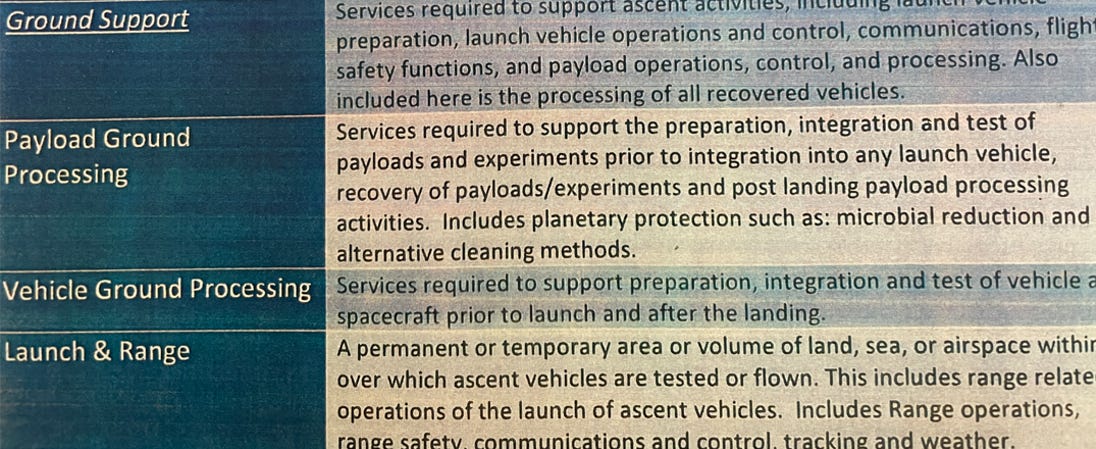
Even though there remains some uncertainty about what the term “Launch Operations” truly means, a truly sensible starting point would to sort through all the KSC and WFF stuff to identify what is and isn’t “Launch Operations”. For example, you could get the Range Commanders Council (RCC) (the nation’s experts in such matters) to help you pick out all the actual stuff from the newly declared portfolio at both sites that maps to “Launch Range”, put that in a bucket, combine it with the WFF Range (which is already well-segregated from both “mission stuff” and “spaceport stuff”). You would call the combination “The NASA Range Complex”. It would consist of range related personnel, instrumentation, airspace, processes, and facilities, and all of it would need a home.
For the Range Stuff, There are Options:
i. From there you could offer it to DoD’s (Major Range and Test Facility Base) MRTFB (which would entail some sort of budget exercise for the agencies or for Congress and would not make a big dent in ‘federal employees’).
ii. Similarly you could offer it to the Space Force since they have launch ranges and know how to handle them. At the Eastern Range this could maybe expand capacity which is already stretched at Eastern Range. (this isn’t a thing you do in a day, though, as vehicles require very specific and expensive infrastructure) At WFF the Space Force is already a frequent user (though, why buy if you can rent as needed?). Again, you wouldn’t see big, if any, reductions in total federal employment and budgetary gymnastics would be involved.
Note that the Navy, which has nearly a LOT of dollars (between 500 million and a billion) of infrastructure investment (there is literally a functioning Aegis Cruiser there, after all) at Wallops. So, the Navy could also receive the offer, but this would really only make sense at WFF since both NAVAIR and NAVSEA are historical users with ongoing mission and physical presence there already. But even with the Navy at Wallops, there is the “why buy it when you can rent when you need it” problem. Also note that from a federal perspective, this (WFF as a Navy asset) sort of splits things up right when you just joined them together, so synergies would be lost.
Lastly, in spite of the reasons I have offered for each federal entity not wanting to pick up a new responsibility and own WFF, there does exist one reason why you might want to leave it in DoD hands. The reason is that WFF offers an optimized location for defending the nation’s capital from a very simple, relatively low-tech, sea-based missile/UAV threat. No more details offered here, but look at a map — it is a short (and very direct) flight from the ocean to DC if you are a bad guy with a little boat, but WFF with its sensors and launch capability is in the way of the worst - case flight paths.
iii. You could also offer it in an RFP to industry and completely commercialize it. The problem here is that both KSC and WFF come with huge ‘hidden infrastructure costs’ in the form of bridges, beach replenishments, and obsolete equipment (not to mention insurance costs that are currently self-insured by the government), that would make making money nigh on impossible in anything at all approaching “the near term”.
Just as an aside here, this is actually a nontrivial problem: Ranges are money-losing propositions. You might point to the commercial (SpaceX) operation in Brownsville, but remember that even there, the range itself is simply the “cost of doing business” where the business is Starlink satellites and whatever else Elon launches in order to make money. That isn’t to say, someone won’t bid if the money is right, but the government won’t spend less than it does now, so, if this is the path, the goal isn’t cost containment so much as ‘getting stuff off the books’ and “giving money to whoever gets the contract’. That CAN be in the national interest in some cases, so I am not poking so much as it may sound.
iv. You could offer it to the Florida and Virginia Spaceport Authorities (separately or, more creatively, I think, to some sort of pseudo cooperative cross-state ‘authority’). My sense is that the states might go for this because of the strong desire in each to continue the growth of their spaceports. To a spaceport, “the range part” feels almost trivial (a normal feeling when something isn’t your job) just as the Range’s tend to feel about the spaceport part. Still, the leap from being a spaceport to being a spaceport + launch range would be harder than either of them realize. But it would not be impossible.
v. (addendum from original posting): You could decide that your goal is not the reduction of "civil servants” but is instead the combination of support contractors. In this option you link together those things that are “Launch Range stuff” at KSC and WFF and issue a combined contract that covers those activities at both sites. This would be standard practice for any normally thinking NASA leader since it plays to every preconceived notion of how to save money in contracts. The savings (and this is just my guess) would be small since, with launch ranges, “you need what you need when you need it and at the strength you need it and if you don’t have that, you are NOGO for launch”. That said, a very rational approach for a contractor who understood that the way to support each site’s operational needs would be to replicate existing ops-day staff at each site. Still, maintenance matters and is a huge cost in range circles, so sharing those personnel (and spare parts) could result in savings so long as there is some commonality in baseline equipment. So, there is a way to thread this needle and have everyone proclaim success, but it is a small needle since there isn’t a lot of equipment commonalty. But, just to close with an important thought: launch ranges are very very local things, even on ‘normal’ days but especially on days when things have gone terribly.
vi. You could just declare that NASA has no need of its own launch ranges anymore than it needs its own Metro stop. You could close both of the range operations down, release the people, auction off the land (beachfront property is good even if it is probably an environmental liability because of 60+ years of launch operations). Without question, this would fail due to congressional objection (and probably reversal) as well as to legitimate needs from users at WFF and KSC who are dependent on them for services. But everyone knows this, so choosing this path is just foolish, and I didn’t even mention the national space security implications of reducing the US’ points of access to the high ground of space.
For the SpacePort Stuff
What is left from an RCC study of “range stuff” would be “spaceport stuff” or “mission stuff”. There would be a lot more spaceport stuff at KSC than at WFF, and there would be “mission stuff” at both places (KSC supports many Artemis elements and WFF builds its own rockets from spare parts to do science missions).
You would omit from consideration the “mission stuff” since it isn’t “launch operations".
Now you would have all the “spaceport stuff” in a bucket. You would have to think very hard about whether or not this stuff belongs to the category of things called “Launch Operations”. The decision has implications, big ones, because getting it wrong means you have either left some gap, created some overlap, stepped onto someone else’s turf, or what-have-you. These are not small things, so you take a moment to do this if you are smart.
But let’s say you do it and even “get it right” and you, Brian, find out that some of what you have in your “bucket” is best aligned with what the Florida and Virginia spaceports (or someone else) is already doing. Then the natural thought would be to offer it to the appropriate spaceports on a sole-source basis. More creative options would be to suggest some Florida-Virginia joint entity to pathfind a more national approach to spaceports OR to even skip the sole source offering in one or both states to see if competition can be spurred. Note that this last thing would be very hard given the startup costs involved and the inherent advantages to scale.
The spaceport stuff would be all the stuff related to preparing a launch vehicle (NASA’s or someone else’s) to launch. There is a lot involved in that and a great reference for that set of work is in a very good recent report by Aerospace Corporation called Spaceportopia and serves as a great primer on the subject if you know nothing about the topic. My discussion of (and links to) Spaceportopia are here.
Misery Made Clear
At this point, the ‘uncertainty and misery’ (for those who work at WFF or KSC) part of my comment should be quite apparent. While all of this maybe represents a growth path for those in the spaceports, for those desirous of the opportunity to make grand pronouncements about efficient government, for Brian Hughes’ future career, and those businesses with the chance to get large-ish contracts for their well-financed and well-connected businesses, the view is very different for the current workforce. For the average civil servant or contractor it means not knowing if you’ll have a job or, if you do have one, where it will be.
That, in itself, represents a risk to the whole scheme since few things are more localized, nuanced, complex, and dangerous than “launch operations”. Without the people who are “doing it now” there to help, any transition will be slow and fraught with risk on every dimension. If they panic and just leave, it could be years before safe and reliable operation is restored across the board.
A Twist That Could Play Out
One last thought. There is also the notion that, rather than offering any or all of these pieces to DoD, states, or industry, the “Launch Operations” elements (at least the launch range portions) could be offered, again in whole or in part, to the Office of Space Transportation at FAA. If you think of launch ranges like you think about airports, this can make sense.
That path would come with some benefits. The sites remain civilian, remain federal, and would be more reassuring to many of the current federal (and contract) workforce. In addition, the analog with airports would be reassuring, and congressional opposition would be muted since federal employment would change less in a given district. Downsides exist, of course, and I think the most significant one has to do with the federal customer sets at the launch sites: they are used to working with non-regulatory NASA rather than regulatory (FAA) launch providers. That seems like wonky “inside baseball” stuff and in some ways it is, but their collective customer experience would surely change. That said, everyone would get used to it, and FAA could (if they really focused on creativity and leaning into the future) bring some “airport like” thinking to the ranges. That wouldn’t be awful.
Note (importantly): Of all the other FEDERAL entities I have named as the possible ‘recipients’ of any NASA attempt to offload any of this, only FAA could legitimately see itself as having something valuable to gain. While DoD and its components would rightly recognize the high and prohibitive carrying costs of the infrastructure and probably choose to “rent rather than buy”, FAA could see a long – sought extension of its influence and authority into an actual operational capability through the acquisition of actual launch range with which it could demonstrate that “ranges are like airports”. If I were in FAA / Office of Space Transportation, I would put some smart people in a room and think hard about the strategic opportunity this represent and whether or not to pursue the “launch part” of what Brian Hughes now leads.
So where to end this?
I am disingenuous if I don’t say right up front that I bleed, feel real pain and heartache, whenever anything affects the nation’s launch ranges, especially the one at WFF where I used to work. A big part of my heart still lives there, and I was very up front about this when I was asked for my thoughts as this was being considered.
I will also offer that I know enough about some of the individuals involved to know that they too often succumb to the wishful thinking that things are simpler than they really are.
I also add what i believe to be a general truth about the way the world works and which makes me somewhat fearful: where wonderful capability, desire for power, and desire for money, are all mixed together, it is wonderful capability that ends up the loser.
So, I worry. That is to say, “I am a little bit paranoid.”. My Wallops training is, therefore, still firmly in place.
I will leave things right there for now and will have the audacity to add my usual style of ending.
Have a great weekend. Remember that YOU are not “your job”. That is just a thing you do.
Just as importantly: If you see the world as dark, be a light. If you see the world as leaderless or poorly led, be a leader. If you see the world as cruel, be kind.
You can do this. I promise.
J